

A Developer’s Guide to Multi-Residential Buildings in Waterloo, Kitchener, Cambridge, and Guelph
Waterloo Region is growing fast, and housing hasn’t kept up. The Region’s population is about 678,000 as of year-end 2024, and long-range forecasts still point to major growth over the coming decades. Region of Waterloo
At the same time, home prices remain high relative to incomes. The average home price in the Kitchener-Waterloo-Cambridge market was about $735K in Oct 2025, keeping affordability stretched even as the market cools slightly. WOWA
That combination — more people, expensive housing, limited ground-related supply — is exactly why small-scale multi-residential infill has become one of the most attractive development paths in the Region.
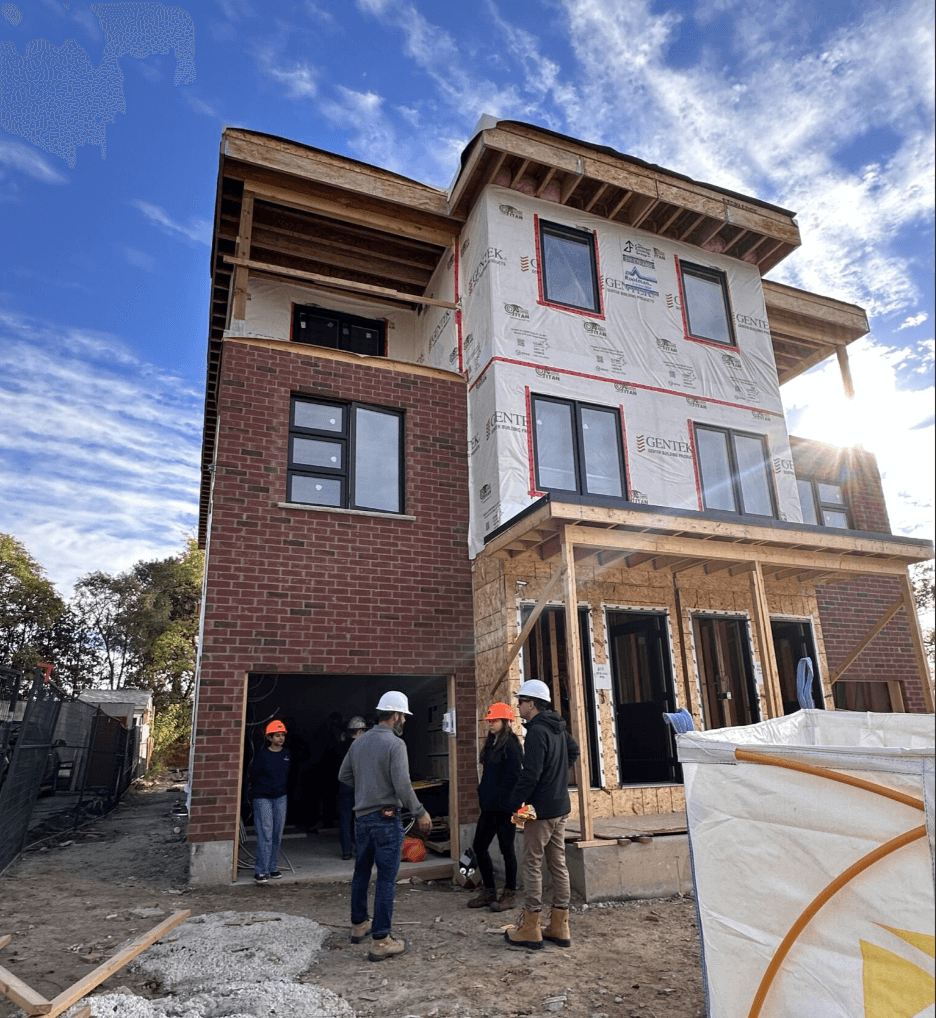
Understanding Multi-Residential Buildings
A multi-residential building is any structure with more than one home inside. Each home (or “unit”) has its own kitchen, bathroom, and entrance, but units typically share one foundation and structural frame.
Common examples include:
- Duplexes and triplexes
- Fourplexes
- Stacked townhomes
- Small apartment buildings (6–12 units)
- Walk-ups and low-rise mixed-use
These projects make better use of land and help cities grow without expanding outward. Planners call this “gentle density” or “missing middle” housing — adding homes inside existing neighborhoods while keeping the scale compatible with what’s already there. University of Waterloo
Why Missing-Middle Infill Is a Great Entry Point for Multi-Res Development
If you’re looking to get into multi-residential development without jumping straight into mid-rise or high-rise, missing-middle infill is the sweet spot:
- Lower land risk: smaller parcels, simpler assemblies
- Faster approvals: municipalities are actively enabling these forms
- Easier financing: more comparable pro formas and exits
- Scalable model: repeatable designs across similar lots
- Huge demand: households priced out of single-family homes still want ground-related options
In short, missing-middle infill is the bridge between single-family builds and larger apartment development and the policy environment in this region is now pushing hard in that direction.
What’s Changing Across Waterloo, Kitchener, Cambridge, and Guelph
Municipalities across the region are rewriting zoning and approvals to unlock small-scale multi-res that fits existing neighbourhoods.
Kitchener — Infill Zones & Four-Unit Housing
Kitchener is enabling up to four units on many lots that previously allowed only single-detached, semis, or townhomes. This is part of the City’s broader housing pledge and gentle-intensification approach. EngageWR Kitchener also received Housing Accelerator Fund support (~$42.4M federal) tied to speeding up approvals and adding supply. Canada Mortgage and Housing Corporation
Waterloo — Expanding Infill Near Transit
Waterloo is doubling down on transit-oriented multi-unit housing along LRT corridors, encouraged by federal-municipal housing acceleration programs. Community Profile
Cambridge — Mixed-Use & “Missing Middle” Housing
Cambridge is focusing on zoning reforms and incentives for low-rise mixed-use and missing-middle forms, aligned with HAF-style targets to add supply quickly. Community Profile
Guelph — Up to Four Homes Per Lot
Guelph has moved to allow up to four homes per property and is using affordability-focused programs to encourage diverse unit types close to amenities and jobs. Community Profile
Bottom line: the rules are shifting toward more units on existing urban land, giving developers a clearer path to profitable small-scale multi-res.
A Few Key Facts to Note About Kitchener-Waterloo (KW)
Instead of a generic “why it matters,” here are the ground truths shaping feasibility right now:
- Population growth is locked in. The Region is already near 678K people and is expected to keep rising sharply through 2041/2051. Region of Waterloo
- Affordability pressure remains intense. Even with recent cooling, the average KW-Cambridge price is still around $735K. WOWA
- Missing-middle is a stated regional priority. Local partners are aiming for 10,000 missing-middle homes by 2030, signaling deep policy support for this product type. University of Waterloo
- Gentle density is now the fastest lane. Fourplexes, stacked towns, and small walk-ups are increasingly “as-of-right” or near-as-of-right compared to larger rezoning plays. EngageWR
- Transit + infill is the development map. Approvals and incentives are concentrating around LRT, GO, and MTSA areas, which boosts long-term demand and rent/sale resilience.
These forces together create a durable thesis: KW needs more ground-related multi-unit housing and policy is now aligned to help deliver it.
Why Choose Eagleview for Multi-Residential Development in Waterloo Region
If you are planning a low-rise multi-residential project in Waterloo Region, the first question is simple: who can you trust to take it from concept to completion without surprises?
Eagleview is built to answer that.
We specialize in 6 to 8-unit, wood-framed, CMHC-ready multi-residential developments across Kitchener, Waterloo, Cambridge, and Guelph. Our integrated design-build model gives developers one accountable partner for planning, design, budgeting, permitting, and construction.
.jpeg)
Real Experience in Residential and Multi-Residential
Eagleview is not new to this. We have over 14 years of residential building experience in the region, growing from custom homes into a focused multi-residential design-build firm.
Every project benefits from:
- Grounded local knowledge of infill and small urban lots
- Hands-on experience with low-rise multi-res buildings
- A track record of delivering 6 to 8-unit projects across the region
This depth of experience means we understand not just how to build, but how to make projects workable in real conditions.
A Structured, Developer-Focused Process
Our project management framework has been refined over more than a decade. It is built to keep your project moving and your risk controlled.
We help you:
- Assess feasibility and pro forma assumptions early
- Align design with budget before drawings go too far
- Maintain visibility on timelines, costs, and decisions at each stage
You get a process that is transparent, predictable, and designed around developer needs, not just construction schedules.
Integrated Design-Build for Fewer Surprises
With Eagleview, design and construction sit under one roof. That means:
- Fewer disconnects between drawings and on-site reality
- Faster adjustments when conditions change
- One team is accountable for both design intent and execution
This integrated model reduces rework, shortens timelines, and keeps projects aligned from first sketch to occupancy.
Trade Relationships and Regional Buying Power
We have long-standing relationships with trusted trades across Waterloo Region. That gives you:
- Preferred pricing
- Priority access to crews
- Consistent quality
Our regional buying power helps control costs and supports reliable delivery, which directly protects your margins.
CMHC-Ready and Financing-Friendly
Eagleview understands the importance of financing, especially when working with CMHC-backed programs. We support developers with:
- CMHC-compliant design and documentation
- Cost modelling and pre-construction planning
- Project structures that align with lender requirements
This financial awareness helps move projects from idea to funded reality.
.jpeg)
Building the Future of Waterloo Region
Whether this is your first multi-residential build or part of a growing portfolio, our systems are built to scale with you. We combine developer-aligned thinking with the execution strength of a residential specialist.
If you are exploring a multi-residential development in Waterloo Region, Eagleview is ready to help you move from concept to completion with confidence.
Request a Developer Consultation to start planning your next multi-res project